Corporate climate commitments increasingly grapple with Scope 3 emissions – the indirect emissions from supply chains that often dwarf a company’s direct footprint. In fact, up to 90% of many companies’ emissions come from Scope 3 sources like supplier operations and raw materials. Yet organizations struggle to curb these emissions because they rely on suppliers to act. This is where carbon insetting comes in. Rather than purchasing offsets unrelated to their business, forward-thinking companies are investing in climate solutions within their own value chains. Insetting represents a proactive, high-impact approach for businesses to address emissions at the source while delivering value for ecosystems and communities connected to their operations.
INSETTING
INTEGRATING CLIMATE ACTION INTO YOUR VALUE CHAIN
WHAT IS INSETTING AND WHY DOES IT MATTER?
Carbon insetting means financing and implementing emissions-reducing projects inside your supply chain or sphere of influence. Put simply, “carbon ‘insetting’ focuses on doing more good rather than doing less bad within a value chain,” often through nature-based solutions like reforestation, agroforestry, regenerative agriculture, or clean energy in sourcing regions. Instead of compensating for emissions elsewhere, businesses support targeted climate action in the places and communities they depend on.
This approach tackles the core of the climate challenge for many industries. Agriculture, forestry, and land use alone contribute about 25% of global GHG emissions. By insetting – investing in better farming practices, forest conservation, ecosystem restoration, and clean technologies in their supply chain – companies directly reduce these emissions and boost the sustainability of their raw material sources. New research suggests that high-integrity insetting could cut agricultural supply chain emissions by up to 68% while also protecting ecosystems and livelihoods. In short, insetting allows companies to turn climate responsibility into an opportunity: reducing Scope 3 emissions at their origin and creating positive ripple effects for people and nature.
INSETTING VS OFFSETTING: CLIMATE ACTION AT THE SOURCE
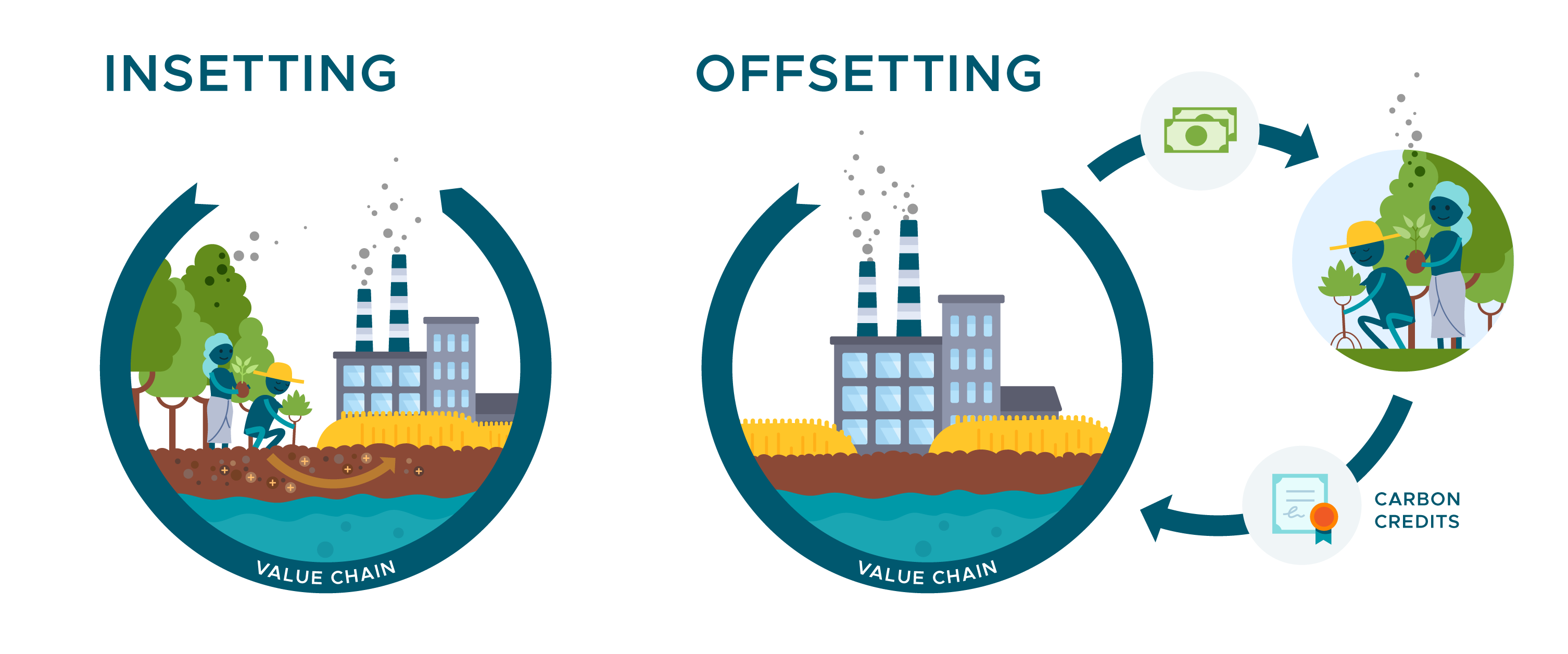
It’s helpful to distinguish insetting from the more familiar offsetting. Both involve supporting projects that reduce or remove carbon, but the key difference is location and linkage. With traditional carbon offsets, a company might pay for tree planting or renewable energy projects outside its value chain – for example, financing reforestation in another country to counteract its emissions. Offsetting can be valuable, but it doesn’t directly clean up the company’s own supply chain. Insetting, by contrast, keeps the climate action inside the company’s sphere of operations or sourcing. The projects are biophysically or socio-economically linked to the business – for instance, on farms that supply a food company, or in communities that produce raw materials.
By reducing emissions within its supply chain, a company can credibly claim progress toward its climate targets without leaning on distant offsets. Insetting directly lowers reported Scope 3 emissions, strengthening the company’s path to science-based targets and net-zero goals. It also avoids some pitfalls of offsetting, such as accusations of “carbon neutral” claims based solely on purchased credits. Insetting projects are part of the company’s own climate journey, demonstrating tangible decarbonization rather than just compensation. Notably, experts encourage using both insetting and offsetting in a comprehensive climate strategy. The priority is to do everything possible in your value chain first (insetting) and then offset any remaining, unavoidable emissions with high-quality credits – a strategy aligned with the Science Based Targets initiative’s guidance for beyond-value-chain mitigation.
BUSINESS BENEFITS OF INSETTING
Adopting an insetting approach offers multiple advantages beyond the carbon reductions alone. Companies implementing climate projects at the source of their value chain can unlock benefits such as:
- Supply Chain Resilience: Insetting can make supply chains more sustainable and resilient. By investing in regenerative agriculture, forestry, or clean energy for suppliers, businesses help their partners become more efficient and climate-resilient. This reduces operational risks (like crop failures or resource scarcity) and can strengthen long-term supply stability. In other words, insetting is an investment in the future viability of your own sourcing areas.
- Emissions Reduction & Climate Targets: Naturally, insetting contributes directly to Scope 3 emissions reductions. These in-value-chain cuts bring companies closer to meeting their climate targets in a credible way. They demonstrate direct decarbonization, which is looked upon favorably by frameworks like SBTi and corporate stakeholders. By reducing emissions internally, firms rely less on offsets and avoid greenwashing risks – their climate claims are backed by real changes in their operations.
- Environmental Co-Benefits: Insetting projects often deliver rich co-benefits for the environment. For example, planting trees on farms (agroforestry) not only sequesters CO₂ but also improves soil health, water retention, and biodiversity habitat. Restoring forests or mangroves in supply regions protects biodiversity and ecosystem services. These actions tackle issues like deforestation and soil degradation that, if left unaddressed, threaten both the planet and the company’s raw material base. In essence, insetting lets a company enhance nature in the landscapes it touches, aligning climate action with nature-positive outcomes.
- Community and Social Impact: A well-designed insetting project creates shared value for local communities. Financing sustainable practices in a supply region can improve farmers’ yields and income (e.g. through better agroforestry or climate-smart farming), support local employment (e.g. tree-planting crews, forest stewards), and empower indigenous or rural communities. Insetting initiatives that respect land rights and involve local stakeholders help ensure fair benefits and stronger community relationships. The result is often improved livelihoods for producers, healthier working conditions (e.g. less pollution from old techniques), and more resilient local economies – all of which feed back into a more reliable supply chain.
- Brand Leadership and Investor Confidence: Companies that embrace insetting demonstrate authentic climate leadership. Because insetting requires a deeper commitment and hands-on engagement, it signals to stakeholders that the company is not just buying its way out of emissions, but actively transforming its business for sustainability. This proactive stance can enhance brand reputation and credibility. Clients, investors, and partners increasingly scrutinize climate claims – seeing a company work directly with its suppliers to cut emissions and protect ecosystems builds trust. Insetting aligns climate goals with core business strategy, which appeals to ESG-minded investors looking for long-term value creation. By “doing good” within their own sphere, companies tell a compelling story of innovation, responsibility, and partnership that differentiates them in the market.
In short, insetting turns climate action into a strategic asset. It helps companies meet emissions targets and deliver tangible value to the people and places that make their business possible.
HOW INSETTING WORKS IN PRACTICE
Implementing an insetting strategy involves a blend of climate science and supply chain management. How can a company get started? Generally, the journey includes:
- Assess Your Footprint and Hotspots: First, analyze your Scope 3 emissions to identify the major sources. Which suppliers, raw materials, or processes drive most of your indirect emissions? This could be dairy farms for an ice cream brand, plantations for a chocolate company, or transportation for a retailer. A thorough carbon footprint and supply chain assessment highlights where intervention will matter most.
- Engage Partners and Set Goals: Insetting is a collaborative effort. Companies should engage suppliers, local partners, and experts to design solutions for those emission “hotspots.” Set clear goals – for example, reducing fertilizer-related emissions by X%, or transitioning X% of suppliers to renewable energy. It’s crucial to ensure alignment and buy-in, as these projects often require changing practices on the ground.
- Invest in Targeted Projects: This is the core – channel funding and resources into emission-reducing projects on site. For instance, a food company might invest in its farming network to implement regenerative agriculture (like composting, cover crops, agroforestry) that cuts methane and improves soil carbon. A fashion brand could support programs with cotton growers to adopt sustainable cultivation and reforestation around farms. A manufacturing firm might help key suppliers install solar panels or energy-efficient machinery. The projects can vary, but they should enable your suppliers or operations to avoid, reduce, or sequester CO₂ within your value chain.
- Ensure Measurement and Integrity: Credibility is paramount. Insetting projects should be monitored and their emissions impact quantified in a measurable, verifiable way. Some companies generate internal carbon credits from these activities (verified by standards like Verra or Gold Standard) but retain them for reporting purposes rather than selling. Others use direct emissions tracking to count the reductions. Either way, follow robust methodologies to quantify the GHG benefits and avoid double-counting. Adopting the emerging “high-integrity insetting” principles can guide you – for example, prioritize real climate impact, ensure local community benefits, and use transparent standards for claims. Independent audits or third-party verifications can lend extra assurance that your insetting results are credible.
- Claim and Communicate Results: Finally, integrate the outcomes of insetting into your climate reporting and storytelling. Reductions achieved through insetting can often be counted toward Scope 3 targets (if they occur within accepted boundaries of your inventory). Even when they don’t neatly fit accounting rules, they still represent beyond value chain mitigation that you should highlight as part of your climate action portfolio. Communicate the full value – “We cut X tons of CO₂ from our supply chain this year by helping 500 farmers adopt agroforestry, while also improving local livelihoods and biodiversity.” Such narratives resonate strongly with stakeholders. They show that your company is tackling emissions at the source and making a positive difference.
Real-world examples of insetting illustrate how it works. For instance, the coffee brand Nespresso realized its sourcing regions were suffering climate impacts, so it established an insetting program to plant native trees on coffee farms in its supply chain. This brought regenerative agriculture benefits – healthier soil, shade for coffee plants, and new income streams from fruits and timber – while also acting as a carbon sink to absorb CO₂. Another example is L’Oréal, which committed to balance all residual emissions exclusively through insetting. They develop projects with their ingredient suppliers to increase energy efficiency, promote low-carbon farming, and support forest conservation where they source natural ingredients. These efforts cut emissions and improve the climate resilience of the very ecosystems their business relies on – protecting both the environment and their supply chain’s future. Insetting is already being embraced by leading companies to drive climate action hand-in-hand with business strategy.
ALIGNING INSETTING WITH YOUR CLIMATE STRATEGY
It’s important to see insetting as a core component of a broader climate strategy, not a standalone initiative. Companies today face pressure to decarbonize in line with global goals – for example, halving emissions by 2030 and reaching net-zero by 2050. Insetting directly contributes to these goals by attacking emissions in the value chain that would otherwise remain “hidden” or unaddressed. By integrating insetting, businesses strengthen their alignment with international climate frameworks and pledges:
- Science Based Targets initiative (SBTi): SBTi emphasizes that companies must achieve deep emissions cuts in their own operations and value chains, and only then neutralize any remaining emissions through offsets. Insetting is a perfect fit for this philosophy, as it drives “inside-out” reductions. SBTi also encourages companies to pursue beyond value chain mitigation (like protecting forests or other carbon sinks) as an additional contribution to global climate action. Insetting can fulfill both needs – it counts toward your Scope 3 targets when done within supply chain boundaries, and it doubles as a beyond-value-chain contribution with co-benefits when projects extend to surrounding communities. In short, insetting helps companies hit their SBTi targets and demonstrate climate leadership beyond those targets.
- Net-Zero Commitments: For companies with net-zero pledges, insetting offers a way to reduce the hardest-to-abate emissions. Scope 3 often includes emissions that a company doesn’t control directly (e.g. farms, suppliers), which is why net-zero strategies can falter. Insetting provides a controlled, intentional mechanism to remove emissions within your value chain so that the “net” part of net-zero relies less on external offsets and more on actual footprint shrinking. This makes net-zero claims more robust and defensible in the eyes of investors, regulators, and the public.
- ESG and Disclosure Requirements: With frameworks like CSRD (Corporate Sustainability Reporting Directive in the EU) and others, companies must disclose not only their emissions but also how they are addressing climate risks and impacts. Insetting initiatives demonstrate concrete action and can be reported as part of climate risk management (e.g. securing raw material supply, engaging communities) and environmental impact. They show that the company is investing in natural capital and climate resilience in tandem with carbon reductions. This integrated approach can improve performance on ESG ratings and compliance with emerging disclosure rules.
Above all, aligning insetting with strategy means making it a win-win for climate and business. Choose insetting projects that dovetail with your business priorities: e.g. if water security is a risk in your supply area, a reforestation or agroforestry project can sequester carbon and improve watershed health. If farmer productivity affects your raw material quality, regenerative practices can cut emissions and increase yields.
FORLIANCE: YOUR PARTNER FOR INSETTING AND NATURE-BASED SOLUTIONS
Starting your business’s insetting journey can be complex – but you don’t have to do it alone. FORLIANCE is a climate solutions provider with deep expertise in developing and implementing nature-based carbon projects worldwide. We specialize in helping companies turn climate pledges into actionable projects on the ground. From crafting a tailored climate strategy to executing high-impact projects, our team supports you every step of the way.
With decades of experience (FORLIANCE has been crafting climate solutions since 1998), we understand both the technical and stakeholder challenges of insetting. Our services include identifying the best opportunities in your value chain, conducting feasibility studies, engaging local partners, and ensuring projects meet rigorous standards for carbon accounting and co-benefits. We create and manage projects that leverage natural ecosystems – forests, farms, wetlands – to sequester carbon and enhance biodiversity, while integrating them into your supply chain seamlessly. Whether it's a reforestation initiative with farming communities in Latin America or a mangrove restoration in coastal supply regions, we ensure each project delivers measurable climate benefits and tangible improvements for local communities and ecosystems.
Let’s Take Climate Action Together
Insetting offers a powerful path for companies to lead on climate change while strengthening their own business foundations. By investing in nature-based solutions within your value chain, you can cut emissions at the source, boost your supply chain’s resilience, and uplift communities and ecosystems that share in your success. It’s a holistic approach that transforms climate responsibility into an engine of innovation and positive impact.
FORLIANCE is here to help you make it happen. With our expertise in sustainable supply chain interventions and carbon project development, we can design and implement insetting projects tailored to your needs. Together, let’s create climate action that not only neutralizes your carbon footprint but also builds a sustainable legacy for your company and the planet.
Contact us to explore how insetting can become a cornerstone of your sustainability journey – and how FORLIANCE can be your partner in delivering climate solutions that grow lasting value.
